Sample Chapter
Elephant in the Pool
Introduction
You Are More Than What They See
We’re all shaped, in part, by how others see us. But what happens when we start mistaking their perceptions for truth?
Imagine the old parable of the blind men and the elephant. Each man touches a different part: the tusk, the leg, the trunk, and draws an entirely different conclusion about what an elephant really is. They’re not exactly wrong. But they’re definitely not right. Their limited perspective becomes their whole story.
Now imagine that same elephant, seen only in parts and misunderstood by every blind hand, jumps into a pool. The splash is messy. The reflective image gets distorted. But the elephant doesn’t care. It plays, it floats, and it remembers it is whole.
Throughout our lives, we are that elephant. Touched by others’ perceptions, judged, labeled, and shaped. We learn to see ourselves in pieces: the responsible one, the rebel, the helper, the strong one, the pretty one, the too-much, the not-enough. And for a long time, we may even believe it.
I know I did.
As the youngest in my family, I was immediately seen through other people’s eyes. My sister, used to being the only child, made it clear I was intruding on her space. Sometimes physically, sometimes emotionally. That dynamic colored our relationship early on.
My father’s view of me was one of fierce protection. From this, I learned to associate safety with being guarded by someone stronger, someone in charge.
My mother, balancing nurturing and independence, taught me to make my own decisions… as long as they were safe and sensible. She often compared my sister and me: two different girls, two different identities. That comparison shaped my self-image in subtle and powerful ways.
These were some of the earliest mirrors I looked into. Not all reflections were clear. Not all were kind.
And it wasn’t just family. Friends, clients, and even strangers all held opinions. Some accurate, some flattering, some that stung. But each time, I felt a tug. A shift. As if someone else’s lens could rearrange who I thought I was.
“We don’t just absorb these perceptions; we internalize them, especially when emotionally immature (children). We perform them. We rebel against them. We shrink, we shine, we shape-shift. Sometimes we lose sight of the whole elephant entirely.
But here’s the good news: perception isn’t fixed. Not theirs. Not yours. And your identity isn’t a sentence; it’s a story still being written.
This book is an invitation to see yourself as a whole person again.
Through my stories: some painful, some funny, some still unfolding, you’ll see how I’ve been shaped and reshaped. I’ll share how identity, like perception, is fluid. I’ll offer tools and reflections that have helped me step out of old mirrors and into my own image.
I hope, as you read, you’ll find parts of your own story reflected here too. I hope you’ll begin to question the labels that no longer fit and try on new ones that feel more true. And I hope you’ll learn how to jump into the pool, messy, free, and whole, letting go of the “blind men’s” stories.
Because you are more than what they see.
You are the whole elephant.
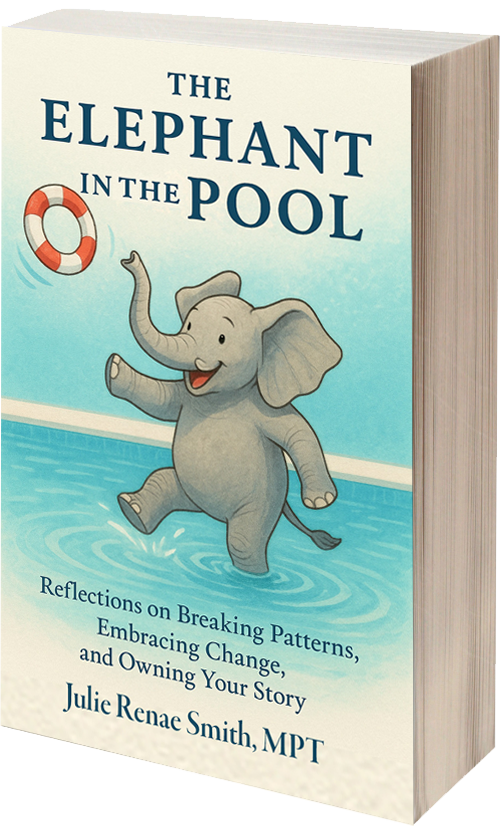
Buy The Elephant in the POOL book.
A Pain Bending™ book.
What if your identity isn’t something to find, but something to reclaim?
Like the elephant in the old parable – where each blind man touches only one part and mistakes it for the whole – we’re often seen in fragments by family, friends, or society.
The Elephant in the Pool is your permission slip to step out of other people’s script and into your own story.
With humor, honesty, and science-backed tools, Julie Renae Smith shares raw and witty stories of identity, loss, and transformation. From cliff dives to foot massage epiphanies, she proves change doesn’t have to be heavy or complicated. Julie shows you how to make change doable – one small shift at a time.
“Julie always creates a safe space… She helps me connect the dots, even when I feel completely lost. And she makes it fun. Yes, personal growth can actually be fun.”
– Angel O., Coaching Client
You’re not just one piece of the story.
You’re the whole elephant.
Now jump in—the water’s ready.
“Life isn’t about finding yourself. Life is about creating yourself.”~ George Bernard Shaw
Pool Rule #1: Even Elephants Can’t Hold Their Reflection Still
Your identity and image will change—no matter how you craft it.
“From the moment we enter the world, pieces of our identity are shaped by the people around us. They are shaped by our families and friends, their expectations, comparisons, and even offhanded comments. But over time, we begin to realize that some of those pieces don’t belong to us.
Finding My Whole Elephant
This is the story of how I borrowed an identity, broke free from it, and began seeing my true self.
I first realized I couldn’t fully control my identity when I was very young. At two years old, I was already inspired by and following in the footsteps of my older sister, who was five. She was learning her colors and spelling them out, and so was I.
I thought, “If she can do it, I can too.” I felt empowered. No one was going to stop me. That belief gave me an early sense of courage and capability. But it also planted a seed: I started to feel like I always had to do more, whether I wanted to or not.
One day, while my mom was telling my aunt about my sister’s triumph with her spelling, my aunt tried to stump me. She challenged“me to spell a non-primary color. “Spell Pink,” she said, confident it would trip me up. With hands on hips and sassy as ever, I replied, “P-I-N-K Pink,” and ran off. I didn’t feel the need to prove anything to anyone. I just knew I could!
My sister was my role model; someone I admired deeply. But at the age of four, everything shifted for me. My mom, upset about some mischief I was making, yelled, “Why can’t you be more like your sister?”
In that moment, my heart broke. I was already doing “everything” she could do; wasn’t that enough? That moment created a deep, painful belief: If I wasn’t more like her, I wasn’t lovable. I wasn’t enough.
That belief followed me for years. I wore that belief like a badge: Be Like Her. Not because I chose it, but because I didn’t know there was another option.
I shadowed my sister through school, friendships, and even chores. I avoided theater and dance, which were her passions. Even when I needed a dance class for gymnastics, I asked her for permission. My identity became wrapped in hers. She became my inspiration, my competition, and in some ways, my poison.
This led to a fractured self-image. I wanted to be “blue”, my true self, but I kept forcing “her” yellow onto it. So even when I felt authentic, I showed up “green”. (Blue + yellow = green.) Tainted. Suppressed. Jealous when she succeeded. Terrified of being less.
I felt like I didn’t have an identity of my own. I was just “Amy’s sister.” That label followed me everywhere. It was like being stuck in someone else’s elephant skin, in a borrowed story.
When I tell this story now, I often pair it with an old parable.
You’ve probably heard the tale of the blind men and the elephant.
Each man touches a different part of the elephant and insists they know what it is.
“It’s a rope!” says the one holding the tail. “No, it’s a wall,” says the one with the side. “A spear,” says another, grasping the tusk.
They all believe they see the whole picture, but none of them do. They’ve mistaken a single part for the whole.
That was me with my identity. I believed being like my sister was the whole elephant. It wasn’t. It was just the trunk.
When we cling too tightly to one story—one strength, one role, one expectation—we stop seeing what else is there. We become the blind man, gripping hard to what we know, and missing everything we don’t.
Here’s the Hard Part
Sometimes, the people around you don’t want to see the whole elephant either.
They like the part of you they’re familiar with. The good girl. The helper. The achiever. The performer. The “be like her” version.
But you feel the rest of you pushing to be seen. You feel the parts of yourself that are funny, bold, weird, and wildly different.
That’s when everything gets uncomfortable.
Collecting Pieces of Myself
Something else was also forming, even back then. At swim meets, I’d sit and rub our adult friend Carol’s feet between my races. My mom tried to convince me to do something else, but Carol always welcomed me. She’d talk to me about anything I wanted to talk about, and always asked, “What do you want to be when you grow up?”
Every time, my answer was the same, with a big smile, “THIS is what I’m gonna do when I get big!”
It was a pure moment. Me being me. Even though the green was still present, my blue showed up, squeezing feet and bringing joy. “Squeezing people’s feet” was and is truly me. In fact, my sister never did anything like it. She still doesn’t. Unlike my sister, I knew from a young age what I wanted to do. And I never wavered. That clarity and passion were uniquely mine.
But the borrowed identity persisted. People assumed I was just like my sister. I even swam her events just because others thought I should. I let myself be put into her box, over and over. I had to be good at everything, just like her. That led to perfectionism. I wouldn’t show anyone my work until it was polished. No room for failure. Just results.
Public speaking was one of the first times I had to be vulnerable. I had to be bad before I got good. That vulnerability was one way that helped, and still helps me, to shift out of the “be like her” mold.
I’m Enough
It took years to understand this.
I didn’t need to “be like her.” I needed to remember the person I was before I thought I wasn’t enough.
I had spent so long grabbing at the tail, thinking it was everything. My sister’s life, my mother’s praise, the stories I thought made me worthy.
But the whole elephant, the whole me, was always there, waiting. Not just the parts that earned approval. Not just the parts that felt familiar or useful. The whole being. The messy, funny, caring, fierce, creative, complicated self.
We are not just one part of the story. We are the story. And we get to tell it differently now.
The Shift
The most significant change for me came when I chose a high school where no one knew my sister. For the first time, I had space to be myself. And once people stopped comparing me to her, I stopped comparing myself. I started doing things she never did: debate, internships, and even sword fighting. I leaned into rebellion. When I did things that my sister did not, it provoked shock and surprise from those closest to me. These reactions unleashed a desire for me to keep surprising them. I enjoyed creating shock and unease. It evolved into both a desire and an ability to play devil’s advocate. I wanted to act, do, and be on the “other” side. I not only rebelled against my parents, but I also rebelled against my sister. This took some doing, but I managed to do it. Weird hair, wild hobbies, and speaking up became my new ways of saying: “I am not her. I am me!”
I was so very different than the previous “expected” version of myself that my mom was genuinely scared of me. That’s how far I pushed.
“I was angry. Motivated. Wild. Alive.
I began stepping into a forceful, authentic version of myself. My true identity began to shine through. I was a powerful blue; no longer green.
That shift allowed me to redefine who I was. I stopped asking for permission. I made decisions based on what mattered to me. And even though I was messy, emotional, and a little chaotic, I was becoming whole. I was forging my new identity.
It wasn’t just about not being her anymore; it was about finally getting to be me. Even if I didn’t know exactly who that was yet, I knew it was worth discovering.”
Identity Can Shift With Purpose
At the age of four, firefighters came to my preschool and showed off their gear. Later that day, my grandma accidentally set the microwave on fire. We called the fire department. But when they showed up, they didn’t have their boots!
I panicked. “Where’s their boots?! Where’s their boots?!” I shouted while running around the house. I was unconvinced they were real firefighters. They were not in the proper uniform!
One firefighter sat me down and explained that they didn’t need boots for every job. It depended on the situation.
It was a revelation and a lesson. Sometimes the tools you wear aren’t what define you. Your identity isn’t your uniform.
At four, I thought a real firefighter had to look a certain way. I didn’t understand that identity could shift with purpose. A fireman without boots might still be fully capable, but I would have stayed confused and scared had it not been explained to me. When I listened to a broader perspective, I learned to see the whole elephant.
The Blind Men and the Elephant parable tells of several blind men, each touching a different part of an elephant and drawing wildly different conclusions. One thinks it’s a wall, another a rope, another a spear. All are partly right. But none see the whole truth.
That’s how identity works. Family, culture, and early experiences give us pieces of ourselves. But if we accept only one piece as a whole, we stay blind. We become the trunk, or the tail, or the tusk, but never the whole elephant.
Our job is to step back and see more. To hear other stories. To ask: What part of this is truly me? And what part have I borrowed, inherited, or been told I must carry?
Elephants, unlike the blind men, are patient and wise. They learn from experience and adapt. They don’t rush to define themselves. They remember, but they also grow.
So must we.
Only now do I see I never needed to “be like her.” I just needed to be fully me. That was always enough.
I’d spent years grabbing at the tail, thinking it was everything. My sister’s life, other people’s expectations, the roles I felt I had to play. But the whole elephant, the whole me, was always there, waiting in the background.
Embracing Change and Resilience
Embracing change allows you to go with the flow. Sometimes when we resist, we cause more obstacles or strife than when we relax into a situation.
Change is inevitable: sunrises and sunsets, tides, seasons. Resisting any of these changes would be like trying to lift an 80,000-pound weight with one finger.
How we perceive and react to a change is within our control. If we allow ourselves to be open-minded and open-hearted, we may find new perspectives, perceptions, opportunities, and people that benefit or accelerate our lives and goals. We also become more resilient in the face of change, whether that is a change of our own making, someone else’s making, or an accident.
I have learned and continue to learn tools and techniques that allow small changes in my life to be positive growth experiences. As I become more proficient in using these tools and techniques in small ways, I have begun to apply them in bigger situations, leading to significant changes. I talk about baby steps. When I first learn a new tool or want to try something that I haven’t done in a long time, I use it in “baby situations.”
Let’s say I’m going out to a camping event and the only shoes that I have are flip-flops and tennis shoes. Can I make a change? I can. I can add boots to the set of footwear that I have. And thinking outside the box, what type of boots? Do I need hiking boots? Do I need rain boots? It depends on the situation. Allowing myself to broaden my perspective and bring additional tools and equipment is a very small way to use this tool.
Broadening Perspective and Developing Curiosity
I have been through many intimate relationship changes, where we brought out the best in each other, until we didn’t. How can I implement small tools in similar situations going forward? Let’s say I’m having a problem once again where the relationship is struggling. Is it possible for me to bring extra tools with me to a conversation with this person? I once cared about this person. I’m sure that I still do, even though they’re bringing the worst out in me. By opening my perspective in this situation, maybe I can learn a new way to have a conversation with them. Perhaps using a conflict resolution tool or taking a moment to pause and take a deep breath before responding“could be helpful. In using a new tool, I’m able to keep an open-minded perspective. This is a way for me to practice using the tool, and by doing so, I develop the muscle of using it. As my comfort level increases with new tools, I can continue to bring them into varying situations.
As a result of using these tools, I have become more resilient. This has made it easier for me (and the other person involved) to end relationships. I usually remain in a friendship with my ex-partners after we part ways.
The parting becomes much more mutual, less aggressive, and it allows me to be resilient in the face of changes within these relationships, whether they end or the relationship evolves. The more I practice embracing change, the more resilient I become when faced with any form of change.
Taking baby steps can add up to taking a big step overall. Consider how you can incorporate a tool or technique to make a small but significant change in your life.
You might begin with something as simple as hanging up a shirt in a different way. You could put your left sock on before your right to change things up. As you practice these little changes, these little tools and techniques, you’ll find that it’s easier to apply them when you have a significant shift in front of you.
The Elephant Within
Your true self is the whole elephant, not just the trunk (achievement), the leg (comparison), or the tusk (rebellion). Just like elephants are wise, patient, adaptable, and deeply connected, your identity is ever-evolving and remembers its past. You are not a fixed statue; you are a living, breathing being in motion.
We must venture beyond limited perspectives that create limiting beliefs if we want to create our true identity. This often requires stepping into the unknown and interacting with change.
Let go of the borrowed boots. Step into your own! You are not just a part of the story. You are the whole elephant. And it’s time the world saw you.
***
“I think I’m funny even if you don’t.”~ Julie Renae Smith
Reflection Questions – Pool Rule #1
Ask yourself:
“What boots am I still wearing that don’t belong to me?”
“What part of the elephant have I mistaken for the whole?”
“If no one were watching, who would I be?”
Three things I want to feel and experience more in my life are:
Where in my life am I living these values fully?
Where am I not?
Does a change you’re making help you live more in line with your values and vision?
We are what we pretend to be, so we must be careful about what we pretend to be.
~ Kurt Vonnegut
Pool Rule #2: Your Herd Taught You to Flinch Before You Felt the Splash
“Long before you made your own decisions, you absorbed the ones your herd made to survive pain and loss.
Families are the first mirrors we ever look into, and sometimes they are the last ones we want to admit still shape us.
Like the blind men feeling the elephant’s leg and mistaking it for a tree trunk, our earliest lessons about pain, loss, and decision-making are shaped by whatever part of the emotional elephant we’re handed. One feels the leg and thinks it’s a tree. One grabs the tail and thinks it’s a rope. If your family’s version of pain was stoicism, then you may believe emotion is weakness. If loss was met with silence, you might think grief should be invisible. If decisions were made impulsively or over-analyzed, you may find yourself now swinging between extremes, never realizing you’re still clutching on to just one part of the elephant.”
We grow up believing this is how you deal with grief, this is how you process pain, this is how you make choices… until we realize that what we learned might not be the whole picture. Or even a healthy one.
Pain – The Scar as a Teacher
In my family, pain wasn’t dramatized. It wasn’t dissected or dwelled upon; it was managed. Quietly. Efficiently. We didn’t “do” doctors unless it was absolutely necessary. We “walked it off,” figured it out, or maybe went to a chiropractor or natural practitioner if things got bad. But attention? Sympathy? Not really part of the prescription. You just dealt with it.
That mindset lives in my bones.
Literally.
It lives within the scar on my right eyelid.
I was eight years old. My dog Buddy, a cranky, misunderstood poodle-terrier with a low tolerance for chaos, was putting up with my overexcited energy the best that he could. I was rough, loud, and always in his face. One day, I leaned in too close, too fast, one too many times. No warning. No growl. Just snap! One bite. Right to the eyelid. Searing pain! It hurt more than anything I’d ever felt.
Blood. Panic. Silence.
For a moment, I thought I’d lost my eye. I remember the urgent care lights, the sterility of the room, the aching burn of antiseptic. Places and things I was not familiar with.
The diagnosis: a cut. No lasting damage. Just a scar.
But the real lesson came later, when we got home. I didn’t get coddled; I got a lecture.
I was met not with comfort, but with clarity.
“You don’t put your face in a dog’s face.”
“Buddy was being good. He could’ve done worse.”
“He gave you a warning bite.”
“You need to respect his space.”
Pain, in my family, came with a side of responsibility. I had crossed a line, not with malice, but with ignorance. I learned a hard lesson that day: respect boundaries. Respect and read energy. Be aware of what’s around you. I learned to pay attention to cues. To see the warning signs before something snapped.
And to take ownership of your part in what happens.
I touched the elephant’s leg, thinking it was just a stable post. But I was standing too close to the power of something I didn’t understand yet.
Loss – The Grief You Can’t See
Grief in my family was handled… differently.
On my mom’s side, it was quiet but shared. Private, but acknowledged. You kept things in the family.
On my dad’s side? You just didn’t talk about it. At all.
“I remember the day I found out my father’s brother had died. The strange part? He’d been gone for six months already when I learned about it. When I asked how he felt, my dad shrugged. “He was my brother. But we weren’t close.” End of story. No tears. No reflection. No sign that the elephant had even moved.
For most of my life, I watched him hold it in so tightly I sometimes wondered if he even felt it.
But now I think he just never learned how to process it. He was given the elephant’s tail, something small and seemingly manageable, and told that was the whole thing.
Until we lost my mom.
That cracked something open. I watched something unravel in him. For the first time, I saw him tear up. Not a full sob, but real, wet, aching eyes. And since then, I’ve seen it a few more times. Quiet grief. I think, in losing her, he also lost the emotional dam he’d built up over a lifetime. It wasn’t a breakdown; it was a softening. The realization that something large and quiet had always been there, waiting.
Watching him has helped me see how grief can come late, or sideways, or not at all. Until one day it does. Now, when I see him grieving, I think he’s touching parts of the elephant he had never dared to approach before. He’s grieving mom… and maybe everyone else he lost but never grieved.
As for me? I’ve always needed to touch what or who I’ve lost. I need contact to believe it. With my friends and clients, it’s not so crucial to have that degree of closure. But with my grandma, my uncle Roland, my ex-husband Leroy, and especially my mom, it was essential. I held their hands, stroked their hair, kissed their foreheads. It’s how I say goodbye. My body processes what my mind can’t always grasp. My mind can lie to me, but my hands know what’s real.
Grieving for My Mom
As reality set in that my mom was dying, I knew I needed to be there, to touch her, to have real closure. We knew this moment was coming soon, so I set things in motion. I made arrangements to be the person to give my mom her final bath.
Elephants are emotional and reverent around their dead, even the bones. They use their trunks to move and wash their fallen. They have a moment of silence and stillness. And then they move their herd to another place.
Much the same, I became the elephant when mom passed. I moved her as gently as I could, closing her eyes and mouth, helping her rest. I washed her very gently and reverently. Taking special care with each part. I used her favorite scents and flowers.
And being true to myself, I also adjusted each part of her to be in alignment and restful.
I asked for calm and caring with my actions, not my words. My dad and sister watched with awe and gratitude as I completed my task.
As I approached the end of the ceremony and celebration of my mom, my sister came to help me wash and comb her hair. It was a task our mom had taught us. It was a task we often completed as a group, helping each other by brushing and styling areas we couldn’t reach or finish on our own. My mom always combed her hair three times after she washed it. Once when it was really wet, again as it began to naturally dry, and a third time to style it. As this was her custom, we did just that. We washed her hair together, the two of us. Then I held her head so my sister could comb Mom’s wet hair. That was combing number one.
A little while later, as her hair began to dry, I held her head again, and my sister completed the second combing. Once the room was cleaned and quiet again, we repeated the process for the third time, styling her hair in her usual way. It made her look like herself. Even her ten-year younger self. She was at peace. I hugged her then, and my sister came over the top of me to hug us both. It was a beautiful, heart-wrenching, calming, horrible moment. It felt like both a flash and an eternity at the same time. I couldn’t believe that my mom was gone!
Many more challenging moments passed as we sorted through the aftermath of her passing, but that particular time was the most instrumental for me in processing the loss of my mom.
I see now that this is how I find the shape of grief. Through my fingertips, I trace the contours of absence. Not only what’s missing, but what mattered, and what was loved.
Decision-Making – The Legacy of Contradiction
Families don’t simply shape how we feel pain or grieve loss; they shape how we make choices, what we trust, what we fear, and what we avoid.
Some of my patterns mirror my mom: deliberate, cautious, methodical, and outwardly emotional. Others mimic my dad: private, internal, stoic. I sometimes keep things so internal that it looks like I’m not even feeling or thinking at all. Then I react based on instinct.
And then there’s the rebel inside me, the one who pushes against both styles and swings wide into extremes, deciding too quickly, or not at all.
There’s a familiar tension:
Walk it off. Or overthink it. Don’t emote. Or emote everything.
This emotional tug-of-war is part of my inheritance. It’s like trying to navigate an elephant by pulling on its ears with one hand and its tail with the other. No wonder decisions feel heavy, like I’m dragging something ancient behind me.
But here’s the thing: just because we inherited a pattern doesn’t mean we’re doomed to repeat it.
My Decision-Making Through Loss
At the age of 18, I lost my favorite uncle. This was no ordinary experience, though. My uncle passed away on my treatment table, near the end of his session, and it had nothing to do with anything I had done.
“We had been trading massage therapy treatments. He had finished working on me 45 minutes before. Then, as I was working on his back, it happened. He contracted his back muscles, causing his head to bob up and down. Three contractions, three head bobs, then a growl escaped his lips. I knew this to be a “death growl”; I knew that sound from my training. In that moment, I not only recognized the sound but learned what the death growl looked and felt like.
That moment was surreal. All thought stopped, truly blank. It felt like I was sucked into a light pulse, collapsing in as the circle of light collapsed, and then expanding further than myself as the light expanded. The moment after that seemed to be an eternity coming.
In the third moment, or maybe heartbeat, I knew I needed to make a decision. Here’s where things got extremely interesting and messy. It was as if everything was happening in slow motion. My first thought was, “I need to get my aunt.” Immediately following this, I internalized the experience; I was stoic and seemingly unable to feel anything. Then, a very methodical decision came, and a deliberate movement on my part to check his pulse and breathing. My breath caught, my heartbeat sped up, and I could feel tears well up in my eyes. Before I had another conscious thought, I heard myself calling to my aunt and felt myself walking into the other room. It was like someone else was controlling my body. I was seeing through my eyes and hearing through my ears, but it was as if I was watching myself from ten feet in the air.
In this moment, my mind and body experienced many swings of my family pendulum. My inaction turning into action mirrored those swings. All this happened in the span of a few heartbeats. My ability to make a decision in that moment was influenced by my family’s behaviors rather than my own, resulting in a disconnected response. So disconnected, in fact, I didn’t have conscious control of my actions.
In this extreme case, it was fortunate that I had some shaping and buffers around my decision-making. This was a situation unlike any I had experienced. If I did not have any family influence, I would have been lost and might not have come back into the situation in time to make a decision. I drew on the learned behaviors of both my parents. Then I took action, adopting my own processing style of placing my hands on him to gain more information and understand the reality of the situation. This combination led me to get my aunt and prepare for what came next.
About a minute later, my aunt and I walked back into the room and rolled my uncle onto his back. At that time, my aunt asked if I could help her do CPR. With my hands on him once again, I noted that he was not breathing and had soiled himself (bladder and bowel). My response to my aunt was simply to shake my head NO. I could not help her with that; I knew my uncle was already gone.
I was able to respond by calling the emergency services and getting them to the house. I have no recollection of the conversation I had with them, and I know I did not remember the house address. Even so, I was able to provide them with enough information. They arrived within five minutes.
While all this was happening, and my body was going through these actions, my focus was on my hands. They were helping me process the situation. I knew my uncle was gone. I knew his energy would be a part of my work going forward. I knew my aunt needed me to be calm and calculated. I knew that this was going to change me. And I knew I needed to reach out to my family for support as the rest of my emotions flooded in.
The more I’ve become aware of my family’s rules, the more I notice these patterns not just in me, but in my family, my work, and my relationships. I begin to see where they came from, and what they cost.
“And I realize: I can challenge them. Change them. Pause them. Reframe them. That pause is powerful. It’s the moment between feeling and reacting. Between instinct and intention; inheritance and choice. It’s where the elephant finally turns, and we begin to see its whole shape. That moment is where growth lives. The moment when I can choose what pieces and parts of my inherited patterns I want to keep as part of my own pattern.
Try This: The Elephant Check-In
- Pause for one breath.
- Check in with all five of your senses. Next, take note of your emotions.
- What are you actually feeling?
- What are you telling yourself about that feeling?
- Are you reacting from habit, or responding with awareness?
- What would you do if you knew you weren’t repeating someone else’s story?
Even a one-second pause can make the difference between repeating the past and reshaping the present. It’s the beginning of new decision-making. The moment between stimulus and response. Between legacy and freedom.
We all carry scars. Some visible. Some invisible.
We all carry family rules, spoken or unspoken. We carry the emotional muscle memory of how to respond to crisis, how to grieve, how to choose; written in bone and memory.
But those rules can be rewritten. That’s how we grow. That’s how we heal.
One scar, one story, one pause at a time.
***
“As much as I like you, I don’t want to see you.”
(In my treatment room. That means something is wrong.)
~ Julie Renae Smith (business “family” culture)
Reflection Questions – Pool Rule #2
Family Teaches You How to Feel and Decide
What patterns or “scripts” did you inherit from your family about handling pain or making choices?
Which of those patterns serve you well today? Which ones no longer serve you?
How might you begin to choose your own responses instead of repeating old ones?
Remember, you get to decide what works best for you on your journey to becoming the whole “elephant.”
Feeling overwhelmed and stressed? What if there was a simple way to change it?
I’d like to give you that gift.
For FREE.
I’d like to give you my video with three stress reducing activities that you can use anytime, anywhere, to build up stress resiliency and make you feel reenergized. You’ll discover simple, easy, and powerful techniques to calm your mind and body. These small, intentional actions can create a ripple effect of stress relief and positive change to help you flow back into “calmer waters” each day.
Grab your free gift now at www.FreeGiftFromJulie.info.
Buy The Elephant in the POOL book.
A Pain Bending™ book.
What if your identity isn’t something to find, but something to reclaim?
Like the elephant in the old parable – where each blind man touches only one part and mistakes it for the whole – we’re often seen in fragments by family, friends, or society.
The Elephant in the Pool is your permission slip to step out of other people’s script and into your own story.
With humor, honesty, and science-backed tools, Julie Renae Smith shares raw and witty stories of identity, loss, and transformation. From cliff dives to foot massage epiphanies, she proves change doesn’t have to be heavy or complicated. Julie shows you how to make change doable – one small shift at a time.
“Julie always creates a safe space… She helps me connect the dots, even when I feel completely lost. And she makes it fun. Yes, personal growth can actually be fun.”
– Angel O., Coaching Client
You’re not just one piece of the story.
You’re the whole elephant.
Now jump in—the water’s ready.